AIDLC vs the ML Lifecycle
"AI development life cycle" means two different things. One is how software gets built with AI agents. The other is how a machine learning model gets framed, trained, shipped, and kept healthy. They are different lifecycles for different artifacts, and a team shipping an LLM-powered feature ends up running both.
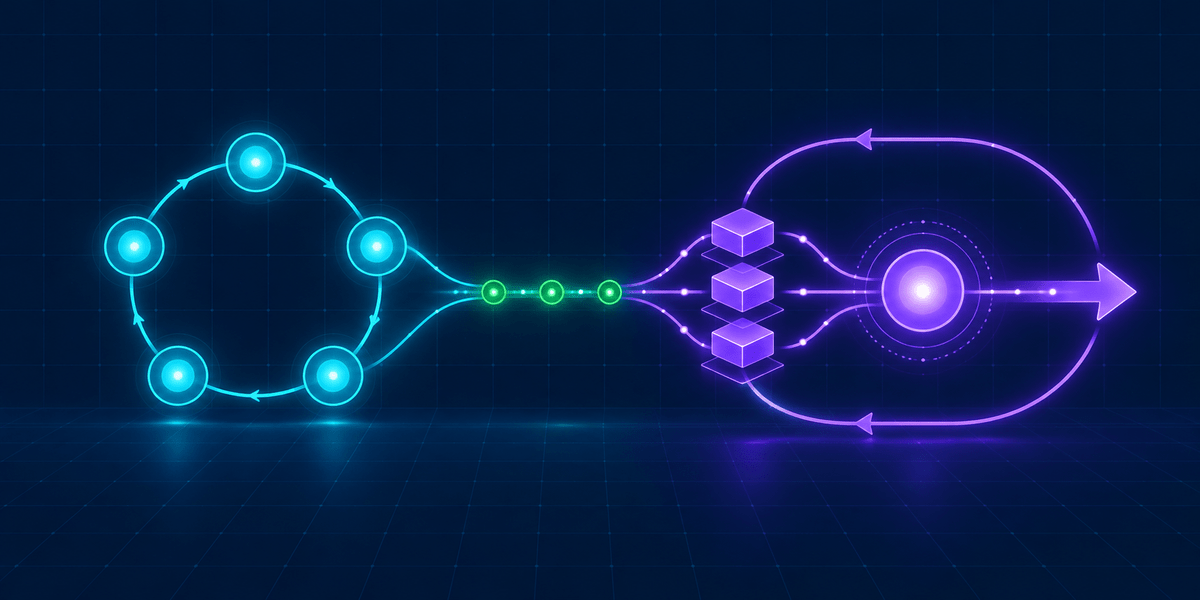
Two Meanings of "AI Development Life Cycle"
Search for "AI development life cycle" and most of the results describe the lifecycle of an AI model: frame the problem, collect and prepare data, train, evaluate, deploy, then monitor and retrain. That is a real and well-documented discipline, and it is not what this site covers.
AIDLC, as documented here, is the lifecycle of software built with AI. Its five phases - Analyze, Ideate, Develop, Launch, and Curate - describe how people and coding agents turn a need into a running product. The AI is part of the toolchain. The product might not contain a model at all.
The confusion is natural: both are lifecycles, both involve AI, and both end in a feedback loop. The difference is what moves through the loop. In the ML lifecycle the thing being developed is a model, and the central risk is that the model is wrong or goes stale. In AIDLC the thing being developed is code, and the central risk is that agent-written code ships faster than anyone can verify it. If you arrived here looking for the first meaning, the sections below orient you and point to the primary references. If you are building with agents, nothing about your process changes, but the last half of this page explains what to add when the product itself calls a model.
Side by Side
The two lifecycles answer different questions. This table compares them on the points readers most often mix up.
| Dimension | AIDLC (this site) | ML / AI model lifecycle |
|---|---|---|
| What is being built | Software: features, services, and the pipeline around them | A model, plus the data and serving pipeline that feed it |
| Where AI appears | In the toolchain: agents plan, write, test, and review code | In the product: the model makes predictions or generates output |
| Raw material | Requirements, tickets, specs, and the existing codebase | Training data, labels, features, and evaluation sets |
| Core risk | Unverified, agent-written code reaching production (the verification tax) | A model that is wrong, biased, or quietly degrades as the world changes |
| What "tested" means | Tests that fail when behavior breaks, scored by mutation testing | Evaluation against held-out data and agreed quality metrics |
| What changes after launch | Code changes through reviewed pull requests | Data changes, so the model needs monitoring and often retraining |
| Typical roles | Developers, reviewers, product owners, platform engineers | Data scientists, ML engineers, data engineers, MLOps engineers |
| Operations discipline | DevOps and release engineering | MLOps for classic models, LLMOps for language-model applications |
Named Lifecycle References
Four references anchor the ML and AI-system side. Each is described here at the level its publisher states; consult the source for the details.
CRISP-DM
The Cross-Industry Standard Process for Data Mining, first presented in March 1999, defines six phases: Business Understanding, Data Understanding, Data Preparation, Modeling, Evaluation, and Deployment. Its phases are not strictly ordered, and practitioners are expected to loop back. It predates modern machine learning tooling but still shapes how teams talk about data projects. See the overview of CRISP-DM.
ISO/IEC 5338:2023
"AI system life cycle processes," published in December 2023, defines a set of processes and concepts for describing the life cycle of AI systems based on machine learning and heuristic systems. It builds on the ISO/IEC/IEEE 15288 systems and ISO/IEC 12207 software life cycle standards, so the non-AI parts of a system keep using those processes. It is a paid standard; see the ISO catalogue entry.
Google Cloud's MLOps guide
"MLOps: Continuous delivery and automation pipelines in machine learning" extends DevOps ideas to ML. Continuous integration also validates data, data schemas, and models, and continuous delivery ships a training pipeline rather than a single package. It adds continuous training, which it calls "a new property, unique to ML systems, that's concerned with automatically retraining and serving the models." Read the full guide.
NIST AI RMF
The NIST AI Risk Management Framework 1.0, released January 26, 2023, is organized around risk rather than process, but it draws a lifecycle view: stages from planning and design through operating and monitoring, with risk management performed throughout the AI system lifecycle. It is the reference to pair with a delivery process when a regulator or customer asks how AI risk is managed. See NIST's framework page.
Where the Two Lifecycles Meet
A team that ships an LLM-powered feature runs both lifecycles at once. Agents may write the application code under AIDLC, while the product calls a model whose behavior has to be framed, evaluated, deployed, and monitored under the ML view. Four practices sit at the seam.
Evals are the test suite for model behavior. A unit test checks that code does what it says. An eval checks that a prompt, model, or retrieval setup produces acceptable output across a representative set of cases. AIDLC already asks for evals for prompts, agents, and review rules; a product that embeds a model needs the same discipline pointed at its own behavior, with cases drawn from real inputs and failures.
Prompt and model versions are pinned. Where the ML view versions datasets and trained models, an LLM-powered feature versions prompts, model identifiers, and retrieval configuration. Pinning turns a model upgrade into a reviewed change that runs the eval suite first, instead of a silent behavior shift. Unpinned means unreproducible.
Data governance is part of the design. What data reaches a model, what a vendor may retain, and which fields never leave the boundary are decisions made in Analyze and Ideate, then enforced in the pipeline. Governance Before Scale covers the policy side; the data-handling decisions for a model-backed feature belong in the ticket contract as data classification and data contract fields.
Drift and quality monitoring extend Curate. The ML lifecycle treats degradation as expected: Google Cloud's guide says monitoring "lets you detect performance degradation and model staleness." In AIDLC terms this extends the Curate phase. Production telemetry for a model-backed feature includes output quality, input distribution, refusal and error rates, and cost, and an escaped failure feeds the next eval set through the learn loop.
How Each AIDLC Phase Changes When the Product Contains a Model
The phases stay the same. What each one has to produce grows.
Frame the problem and the data
Add the ML framing questions: is a model the right tool, what does "good enough" mean in measurable terms, and does the data exist, with rights to use it? This is where CRISP-DM's business and data understanding phases fit.
Design for uncertainty
The design has to say what happens when the model is wrong: fallbacks, human review points, and user-visible confidence. Acceptance criteria include an eval threshold, not only a Gherkin scenario.
Two kinds of change
Agents still write code under the work classes and lanes in place. Prompt, model, and retrieval changes are treated as code: versioned, reviewed, and gated on the eval suite. Prompt edits are not exempt from risk tiers.
Stage the exposure
Release behind a flag, compare against the incumbent, and keep a rollback path to the previous model or prompt version. The ticket contract's rollback plan and blast radius fields apply directly.
Monitor behavior, not only uptime
A healthy server can still return worse answers than last month. Curate adds quality sampling, drift checks, and a standing process for turning bad outputs into new eval cases. Teams measuring the whole effort should keep outcome metrics separate from model metrics, so a model-quality gain is not credited to the coding agents or the reverse.
When to Reach for Which
Use AIDLC alone when agents help you build ordinary software and the product contains no model. The risks to manage are review load, test quality, and governance, which the Playbook covers.
Use the ML lifecycle alone when you are training and serving models and writing the surrounding code by hand or with light assistance. CRISP-DM, MLOps practice, and ISO/IEC 5338 are the better-fitted references, and the other framing on this page is a side note.
Use both when agents build a product that calls a model, which describes most teams shipping an LLM-powered feature today. Run AIDLC as the delivery loop, add evals, pinning, and data governance at the seam, and let the ML references supply vocabulary and monitoring practice. A regulated team should add ISO/IEC 5338 or the NIST AI RMF as the audit-facing frame.
Neither lifecycle replaces your team's process framework. For how AIDLC sits inside sprints and boards, see AIDLC With Scrum and Kanban. For a concrete run through the five phases, see the worked example; for the people side, Teams and Skills; and for inherited codebases, Legacy Code.
Frequently Asked Questions
No. The ML lifecycle covers building and operating a model: problem framing, data collection and preparation, training, evaluation, deployment, and monitoring and retraining. AIDLC covers building software with AI agents through five phases - Analyze, Ideate, Develop, Launch, and Curate. A team shipping an LLM-powered feature usually needs both.
Not if the product itself contains no model. Coding agents sit in your toolchain, so the disciplines that matter are review capacity, mutation-scored tests, and governance. Once your product calls a model, add evals, prompt and model version pinning, data governance, and quality monitoring in production.
ISO/IEC 5338:2023, "AI system life cycle processes," is the international standard for describing the life cycle of AI systems based on machine learning and heuristic systems. CRISP-DM is an older data mining process, Google Cloud's MLOps guide covers automation pipelines, and the NIST AI Risk Management Framework adds a risk view. None of them is a software delivery methodology like AIDLC.
Two Lifecycles, One Product
Learn the five-phase delivery loop first, then add the model-specific practices where your product needs them.