AIDLC Executive Brief
A skimmable brief for a CTO, VP or director, written so an engineer can forward it as is. It covers what AIDLC is, the problem it answers, the five phases, what changes for the organization, what it costs, what to measure, the risks of doing nothing and of doing it badly, a 90-day plan, and the decisions only leadership can make. Every figure carries a named source in its sentence; every link goes to the page with the detail.
AIDLC in One Paragraph
AIDLC, the AI Development Life Cycle, is a way of running software delivery when AI agents write much of the code. It keeps five phases - Analyze, Ideate, Develop, Launch and Curate - and puts the human effort where it now matters most: defining the problem clearly before an agent starts, approving a plan, verifying the result with tests and review, releasing with a rollback, and turning every defect into a rule. The agents get speed; the organization keeps accountability. It is a delivery method with controls, not a tool purchase.
The Problem: Authoring Got Cheap
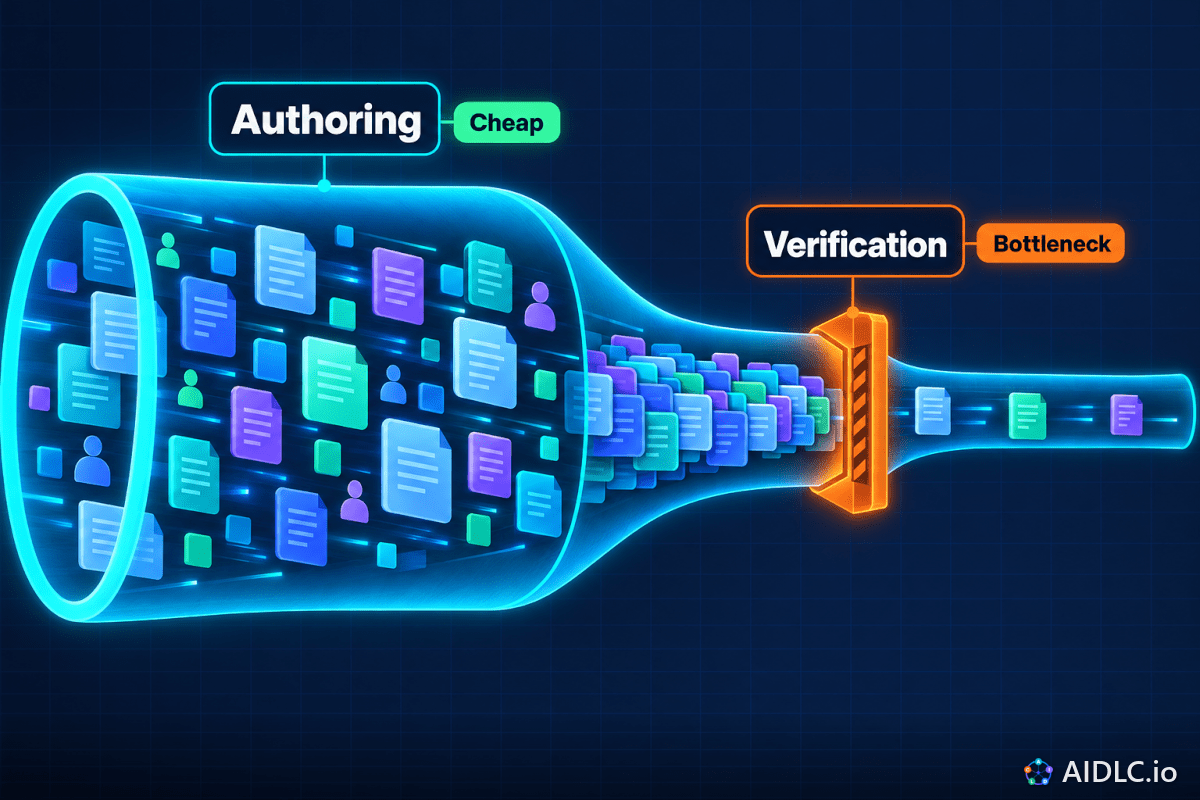
Writing code used to be the slow, expensive step. With agents it is fast and cheap. Verification, meaning review, testing and the confidence to ship, did not get faster at the same rate, so it became the bottleneck. The evidence is mixed in size but consistent in direction. Details and caveats are on The Productivity Paradox.
Faros AI, 2026
Faros AI's "AI Engineering Report 2026" (March 2026, 22,000 developers across 4,000 teams) found tasks per developer up 33.7% while median PR review time rose 441.5% and incidents per PR rose 242.7%.
METR, 2025
METR's randomized trial (July 2025) found 16 experienced open-source maintainers were 19% slower with AI tools, yet afterward believed they had been 20% faster. METR's February 2026 update called its newer, more favorable results "very weak evidence". Perceived speed and measured speed diverge.
DORA, 2025 and 2026
DORA's 2025 report found AI adoption positively linked to throughput but still negatively linked to stability, framing AI as an amplifier of existing strengths and weaknesses. Its 2026 ROI report names the verification tax: the review and validation cost AI shifts onto humans.
What this means for a leader: buying tools raises the volume of change, and volume without verification raises risk. The return comes from the surrounding method, which is what AIDLC supplies.
The Five Phases in One Table
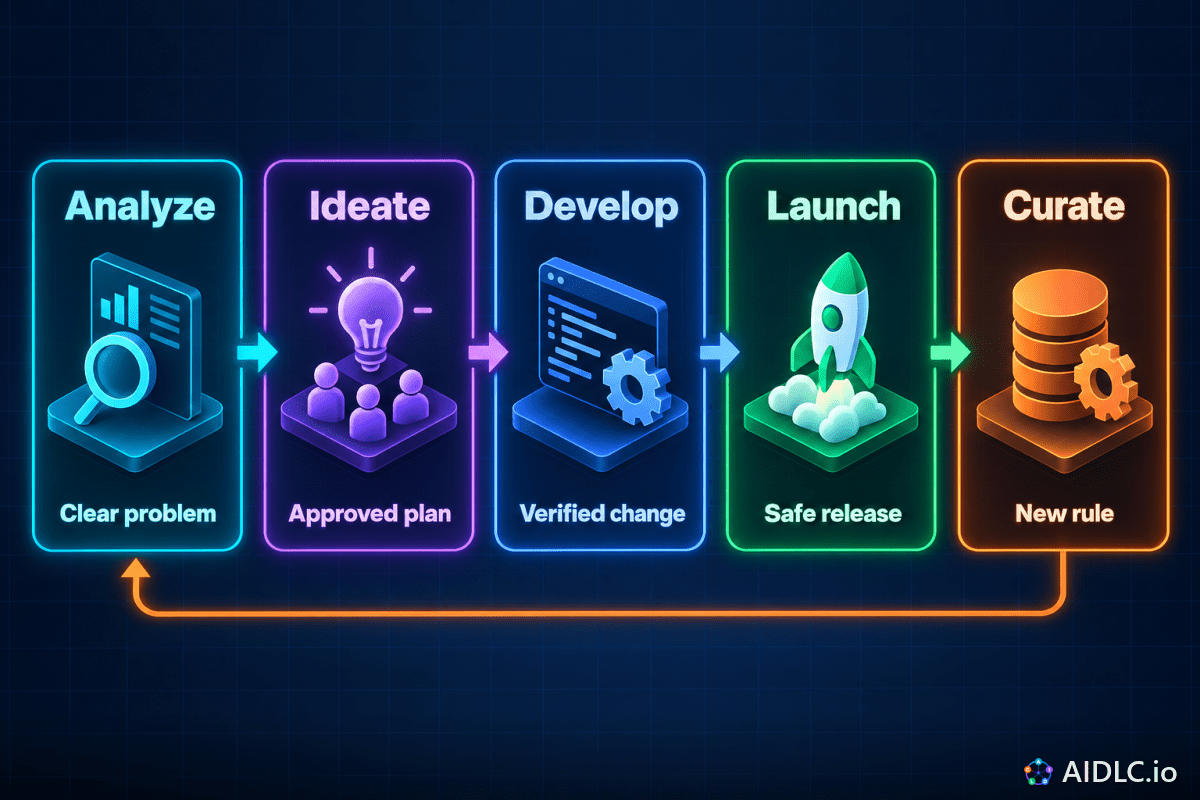
Each phase has one outcome a leader can ask about. If a team cannot show the outcome, the phase was skipped.
| Phase | What happens | The outcome | The question to ask |
|---|---|---|---|
| Analyze | The problem is defined and signed as a brief with acceptance criteria | A clear problem | Could two engineers read this the same way? |
| Ideate | Design options are weighed and a plan is approved by a named person | An approved plan | Who approved the approach? |
| Develop | Agents build against tests written first; humans review | A verified change | What proves it works, and who reviewed it? |
| Launch | The change ships behind a flag with a release plan and rollback | A safe release | How do we undo it? |
| Curate | Results are measured and every defect or incident becomes a rule | A new rule | What did we learn, and where is it written down? |
What Changes for the Organization
Little changes in the org chart. A lot changes in where people spend their attention.
Engineers
Spend less time typing and more on defining problems, reviewing plans and verifying results. See Teams and Skills.
Product
Owns the problem statement and the acceptance criteria, which become the input an agent works from. Vague requests stop being cheap.
Security and compliance
Join early to set data tiers, agent permissions and vendor terms, and receive evidence as a by-product. See Security and Compliance.
Leadership
Sets the policy, funds verification as well as generation, and judges progress against a baseline rather than activity. See Governance Before Scale.
What It Costs
This page deliberately gives no dollar figure: the numbers depend on your team size, tools and usage, and a made-up benchmark would mislead. The cost model shows how to build your own.
Three buckets, one budget line
Spend splits into three buckets, and the variable, usage-based one is the bucket that surprises teams. Put them under one owner so the total is visible.
Controls before scale
Per-workflow budgets, attempt limits and hard caps stop a runaway agent loop from becoming a surprise invoice.
Fund verification too
If the budget covers generation but not review capacity, tests and tooling, the bottleneck moves nowhere. Report unit economics, not just totals.
What to Measure
Capture the baseline before agents touch anything, then report against it. The measuring impact page defines each metric and the measurement stack behind it.
- Cycle time from ticket to production
- Pull request review turnaround
- Change failure rate
- Bug escape rate
- Test coverage and mutation score
- Deployment frequency
- Developer satisfaction, by survey
Read the set together. Speed numbers that rise while change failure rate and review turnaround also rise are the pattern the research above describes, not a success.
Risks of Doing Nothing vs Doing It Badly
Both options carry risk. The point of a method is to choose the smaller one deliberately.
Doing nothing
- Engineers adopt tools on their own, outside any policy, with no inventory and no data rules
- Competitors and vendors set expectations your delivery speed has to meet
- Talent expects modern tooling, and the absence of a sanctioned path pushes people toward unsanctioned ones
Doing it badly
- Generation scales while review does not, and quality problems arrive later, as the Faros AI figures above suggest
- Reviewers rubber-stamp confident-sounding changes, so defects reach production unexamined
- Sensitive data reaches a vendor, or an agent holds access it should not
- Spend grows without a baseline to show whether it paid off
The recurring ways rollouts go wrong are catalogued on Failure Patterns.
The 90-Day Plan at a Glance
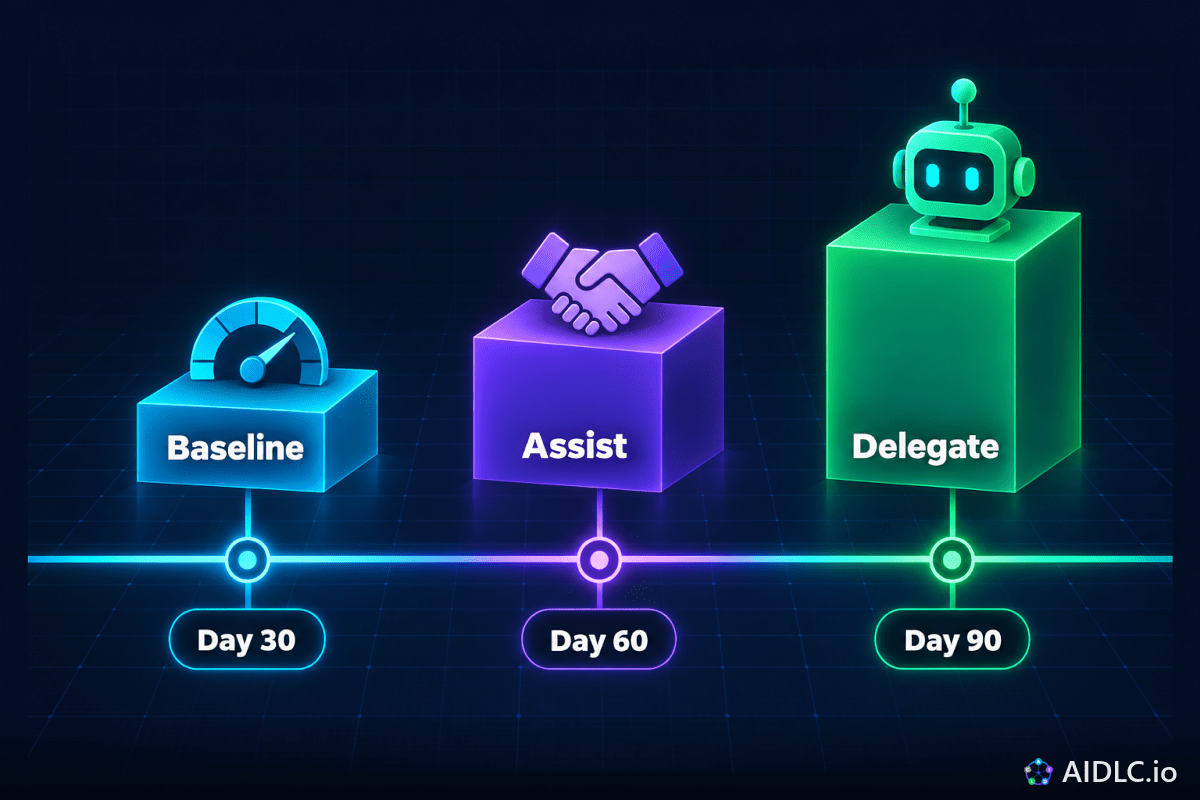
The first 90 days cover the opening of the rollout playbook, which runs longer: Baseline and Configure, Assist, Delegate, then Compound. The aim of the first quarter is a measured baseline, a working policy and one team delegating safe work, not a company-wide change.
Baseline, by Day 30
Baseline and Configure
- Capture the metrics above as the baseline
- Write the policy, data tiers and vendor decisions
- Set agent permissions and spend caps
Assist, by Day 60
Agents draft inside the existing loop
- A pilot team uses ticket contracts and tests first
- A human owns every merge
- First comparison against the baseline
Delegate, by Day 90
Begin the safe work class
- Unattended agents take a low-risk class of work
- The learn loop starts turning defects into rules
- Leadership review: expand, hold or fix
Decisions Leadership Must Make
An engineering team cannot settle these alone. Each one blocks a phase of the rollout until it is answered.
| Decision | Why it needs leadership | Where to read more |
|---|---|---|
| Which tools and vendors are approved, and at which data tier | It sets legal, security and contract exposure | Governance |
| What agents may do without a person, and what stays human-only | It decides accountability when something goes wrong | Agents in the Pipeline |
| Who owns the budget and the spend controls | The variable bucket crosses team lines | Cost Model |
| How success is judged, and against which baseline | It prevents activity counts from standing in for results | Measuring Impact |
| Which team pilots first, and how much review capacity it gets | Verification is the bottleneck, so it needs protected time | Rollout Playbook |
| What the organization promises its own leaders and customers | Over-promising early is the common failure | Maturity Model |
A One-Page Brief to Forward
A template an engineer can fill in and send upward. Replace the bracketed parts with your own facts; keep it to one page. The example wording is invented.
TO: [CTO / VP]            FROM: [name]            DATE: [date]

THE ASK (one sentence)
  Approve a [length]-day pilot of AIDLC on [team], with [owner] accountable.

WHY NOW
  [Where we use AI tools today, and what is unmanaged about it.]
  Authoring is cheap; verification is now the bottleneck (see the
  Productivity Paradox page for the sourced evidence).

WHAT WE WILL DO
  Analyze -> Ideate -> Develop -> Launch -> Curate, on [scope].
  Baseline first, then agents draft, then a safe class is delegated.

WHAT IT COSTS
  Tools: [x]     Variable usage: [y, with a hard cap]     Time: [z]

HOW WE WILL KNOW IT WORKED
  Cycle time, review turnaround, change failure rate, bug escapes,
  versus the baseline captured on [date].

RISKS AND CONTROLS
  Data: [tier rules].   Access: [agent permissions].   Spend: [caps].

DECISIONS NEEDED FROM YOU
  1. [Approved tools and data tier]
  2. [Pilot team and review capacity]
  3. [Budget owner]

NEXT REVIEW: [Day 30 / 60 / 90 date]Frequently Asked Questions
AI agents made writing code cheap, but verification did not get cheaper, so it became the bottleneck. AIDLC is a five-phase method, Analyze, Ideate, Develop, Launch and Curate, that puts human effort into defining the problem, approving a plan, verifying the result, releasing with a rollback and turning defects into rules. It is a delivery method with controls, not a tool purchase.
Individual output rises, but the research is mixed on delivery. Faros AI's 2026 report found tasks per developer up 33.7% alongside a 441.5% rise in median PR review time, METR's 2025 trial measured experienced developers 19% slower while they believed they were faster, and DORA links AI adoption to throughput but not to stability. Measure against your own baseline before claiming a gain.
Plan for a measured baseline and a working policy in the first 30 days, a pilot team using agents with a human owning every merge by day 60, and a first safe class of delegated work by day 90. DORA's 2026 report describes a J-curve in which productivity dips before it rises, so judge the first quarter on baselines and controls rather than on speed.
Start With the Baseline
Fill in the one-page brief, send it upward, and capture the baseline before the first agent runs.